
What one retatrutide shot did to my HRV, and why you shouldn't do this alone
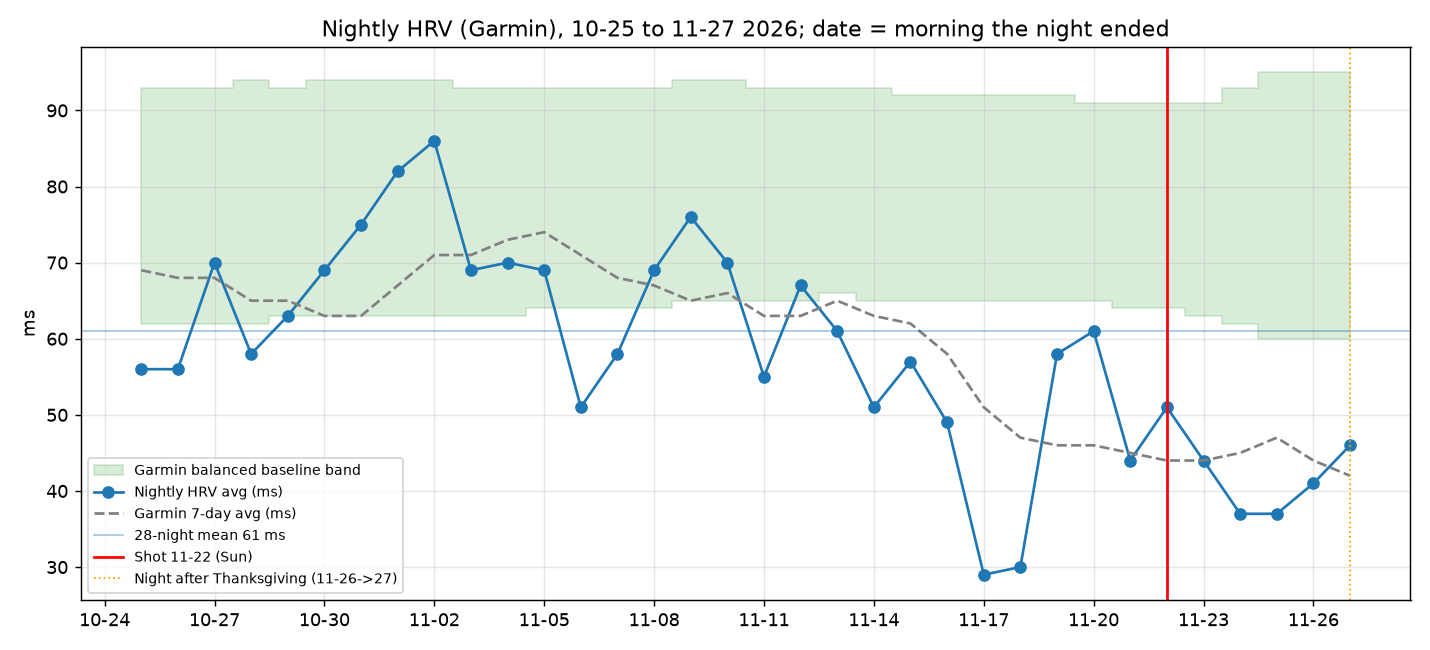
I track my heart rate variability (HRV) and resting heart rate every night on a Garmin. Here's what the last two weeks looked like.
The flu week
In mid-November I caught the flu. I couldn't sleep and my body was in really bad shape. My overnight HRV, which had averaged about 65 ms in the three weeks before, dropped to 49, then 29, then 30. Those last two nights I slept 4.3 and 4.9 hours.
Large wearable studies show that illness typically raises heart rate and lowers HRV [1]. In one Apple Watch study, HRV changed before COVID-19 was even diagnosed [2]. Fitbit data tracked flu-like illness across US states through elevated resting heart rates [3].
The recovery
As I got better, my HRV came back: 58, then 61. My average over the previous 28 nights was 61.
The shot
On Sunday, November 22, I took one shot of retatrutide. Retatrutide is Lilly's investigational triple agonist, acting on GLP-1, GIP and glucagon receptors. It is not FDA-approved. Lilly says it "cannot be legally sold or marketed for human use" [4], and the FDA says it cannot be compounded [5].
The five nights after the shot, my HRV was 44, 37, 37, 41 and 46 ms, an average of 41. My resting heart rate was 58 to 60 every day. In the four weeks before, including the flu, it ranged from 48 to 57. I've been more tired, and my watch keeps telling me my body is under pressure.
What the research says
- Heart rate going up is expected, and it scales with dose. In the phase 2 obesity trial, "dose-dependent increases in heart rate peaked at 24 weeks and declined thereafter" [6]. At week 48 resting heart rate was up 1.7 to 6.0 bpm depending on dose, vs 0.4 on placebo [7]. In that trial, fatigue was reported by 9.7% on the 12 mg dose vs 4.3% on placebo [8].
- The glucagon part matters. Drugs that add glucagon to GLP-1 tend to push heart rate higher than GLP-1 alone, because glucagon stimulates the heart [9]. In one 32-day trial, cotadutide (GLP-1 plus glucagon) raised heart rate by 14.1 bpm vs 3.1 on placebo [10]. A lab study found retatrutide increased the contraction force of human heart tissue through all three of its receptors [11].
- There is a reason HRV could drop. GLP-1 receptors are found in the heart's pacemaker, the sinoatrial node [12]. In animals, activating them in the brain reduces the vagal "brake" on the heart [13].
- HRV on this class of drugs has been measured, just not for retatrutide. No retatrutide trial I could find has published HRV. In a randomized 24-hour Holter study, liraglutide lowered SDNN (a standard HRV measure) by about 34 ms and raised heart rate by about 8 bpm [14]. A 2026 study found that 12 weeks of GLP-1 drug treatment lowered several HRV measures in people with type 2 diabetes [15].
- Other people are seeing it too. Researchers analyzed Reddit posts from people using unapproved retatrutide. Among 7,823 who reported a symptom, fatigue was the most common (15.2%). They also coded "heart rate increased" (4.8%) and "HRV decreased" (0.6%) [16].
What I can't say
I want to be honest, because this has to hold up in front of a skeptical doctor.
- This is one person and five nights. My HRV was already a little off the two nights before the shot (44 and 51), and my resting heart rate had started climbing.
- I also played hard tennis on the Saturday before the shot and twice in the days after, and my watch flagged me as overreaching.
- A wrist watch is not an ECG. Its HRV readings can lag and differ from a medical-grade measurement [17].
- In one semaglutide study, the HRV drop disappeared once heart rate was accounted for. The authors say a higher sleeping heart rate after starting these drugs "may be an expected effect, not illness" [18].
- The heart rate rise in trials tends to ease over time [6][19], and weight loss usually improves HRV in the long run [20].
So I'm not claiming retatrutide harmed me. After one shot, my numbers moved the way the pharmacology predicts, and no one was watching them with me.
Why this matters
This is exactly why you shouldn't do this alone. First, you don't know what you're injecting. When researchers tested three online vials labelled 10 mg, they contained 5.1, 19.0 and 16.5 mg [21]. "10 units on a syringe" can mean a very different dose from one vial to the next.
Second, you don't know how your body will respond. Heart rate effects differ by person and by dose. A drop in HRV can mean illness, overtraining or the drug, and sorting that out takes someone who knows your history.
Third, the stakes are real. CBS News reported two deaths in the FDA's adverse event database tied to bootleg retatrutide, along with rising poison-center calls. Those reports don't prove the drug caused the deaths [22].
That's why u-wellness exists
Medicine works best with a doctor who knows your history, a known product and a known dose, labs before you start, and someone who looks at your numbers when they change. That's what we do at u-wellness.
Don't take these drugs on your own.
Sources
- Natarajan et al., npj Digit Med 2020
- Hirten et al., J Med Internet Res 2021
- Radin et al., Lancet Digit Health 2020
- Lilly press release, Jul 2026
- FDA, "Concerns with unapproved GLP-1 drugs"
- Jastreboff et al., NEJM 2023
- Zhang et al., Eur J Med Res 2026
- ClinicalTrials.gov NCT04881760 results
- Ji et al., Nat Commun 2023
- Parker et al., Diabetes Obes Metab 2022
- Neumann et al. 2025
- Baggio et al., Endocrinology 2018
- Griffioen et al., Cardiovasc Res 2011
- Kumarathurai et al., Diabetes Care 2017
- Front Endocrinol 2026
- Sehgal et al., JAMA Netw Open 2026
- Ben-David et al., Sports Med Open 2026
- Krongauz et al., medRxiv 2026 (preprint)
- de Lemos et al., Hypertension 2024
- Karason et al., Am J Cardiol 1999
- Piatkowski et al., Drug Alcohol Rev 2026
- CBS News, Oct 2026
Continue Reading